A verified marketplace for month to month rentals
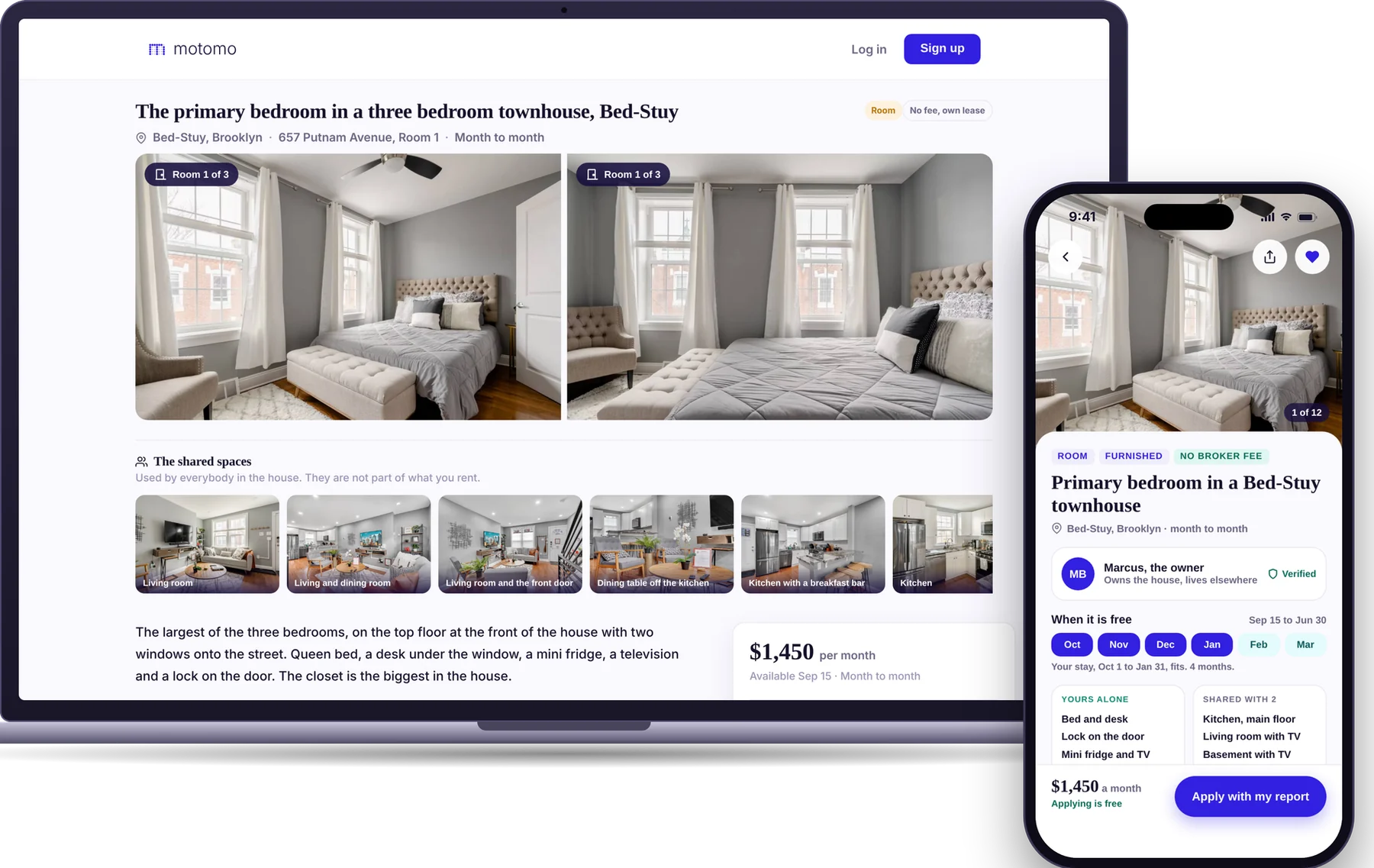
Motomo is a marketplace for furnished rentals of 30 days or more. It verifies renters and listings once, so landlords can trust flexible renters and renters stop paying application fees again and again. It's an active project, and I'm still designing and exploring to find product market fit.
Why I built it
Strong conviction from living the problem
Motomo started from conviction rather than a brief. I run furnished rentals myself, so I knew where flexible renting breaks before I designed anything.
- years hosting on Airbnb, as a Superhost and Guest Favorite
- 12+
- cities managing short and mid-term rentals, Brooklyn and Philadelphia
- 2
What I kept seeing
- Landlords distrust month to month. They assume flexible terms mean risky renters, so good renters get turned away.
- Renters pay to apply again and again. Each application adds another fee to prove the same facts. Motomo has no application fee.
- Listing sites verify no one. They collect leads, which leaves room for fraud on both sides.
The bet: verify both sides once, then let working prototypes prove it with real renters and landlords.
Who it serves
People with a plan and a timeline
A common worry from landlords is that month to month means transient renters. In practice, the people who choose flexible terms usually have a next step with a date on it: a job, a program, a repair or a move.
Early career professionals
New to a city for a first job, learning it before a long lease.
Students
Grad students, interns and visiting researchers here for a semester.
Digital nomads
Remote workers who live in a city for a season, then move on.
Insurance housing
Families displaced by a fire or flood, with rent paid by their insurer.
Corporate housing
Relocating employees, often paid for by the employer.
A four-sided marketplace
Each side wants something different from the same record. Renters want furnished housing they can trust. Landlords want more than a standard lease pays, and Airbnb hosts want similar income with less hassle. Agents and brokers want verified tenants to bring to clients. Agencies that place travel nurses and relocating staff want verified units in the shape their intake needs. The verified report and the verified listing are the shared objects every side reads from.
The shift
From lead capture to a verified match
Legacy listing sites
Built for lead capture
- Listings exist to collect inquiriesNo one is vetted before they reach out.
- Screening is on someone elseLandlords screen on their own, or renters pay for every screening.
- Paid by commissions or subscriptionsWhether or not the match is good.
Motomo
Built for a verified match
- A consumer report for rentersEverything a landlord needs to decide, in one report the renter owns.
- Fraud prevention on both sidesRenters are verified, and so is every listing.
- No application feesThe information already exists, so renters don't pay to apply.
- Criteria and side by side comparisonLandlords set what matters and compare renters against it.
- Multiple offers, faster fillsLandlords with several units can make more than one offer.
Preventing rental fraud
Every fact is checked at the source
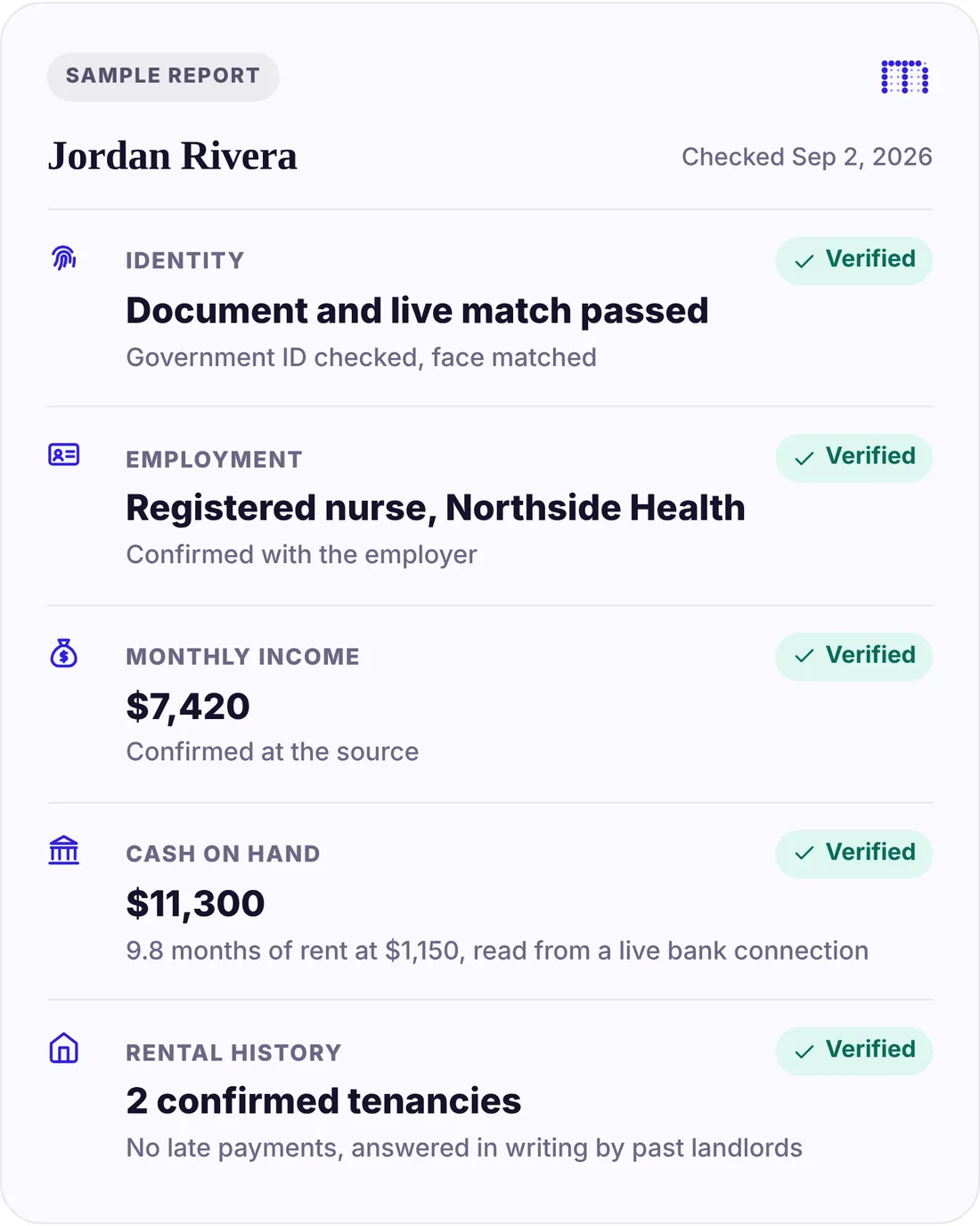
Rental fraud works because nobody checks. Motomo checks each fact where it lives instead of trusting what an applicant types.
For renters
- Identity with biometrics, matching an ID to a live selfie
- Employment confirmed by HR, or through the hiring portal
- Cash on hand through a bank connection
- Rental history confirmed directly with past landlords
- Criminal background requested only after an offer, as its own step
For listings
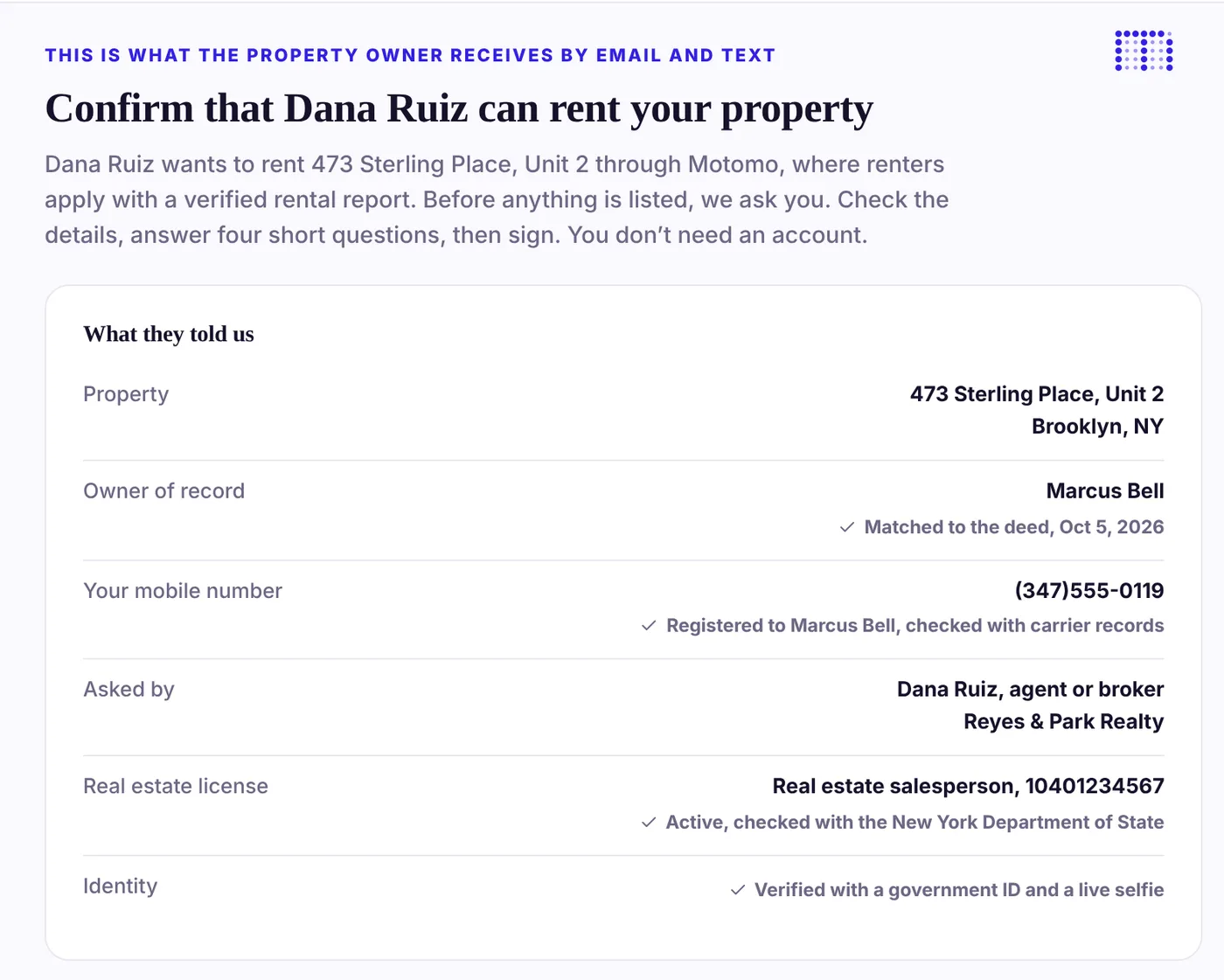
- Owners matched to the deed
- Tenants renting rooms confirmed by their landlord
- Property managers and agents license checked, then the owner confirms
Fair housing and compliance
Built to follow fair housing law from the start
Screening renters is regulated, so compliance shapes the design instead of being added later. The report is built to comply with the housing laws in New York City and Philadelphia, with protocols in place to prevent bias and discrimination.
- No renter scores. Landlords see each fact against their own criteria and make the call themselves.
- Nothing reveals a protected class. The report only shows the facts a landlord can lawfully use.
- Criminal background only after an offer, as its own step, in line with fair chance housing rules.
- Fair housing flags catch discriminatory language in listings and landlord criteria before they go live.
- Notices from a closed list of reasons, so every decline is explained in plain, lawful language.
- Every check is logged, so decisions can be reviewed later.
AI in the platform
AI does the legwork. People make the call.
Verify
Public records, business records, pay stubs and statements read and matched.
Chase
Follow-ups run on their own when HR or a landlord goes quiet.
Protect
Stolen listing photos, too-good-to-be-true rent and fair housing issues flagged early.
Explain
A criteria copilot turns plain English into lawful criteria, and each report section is explained in plain language.
AI handles the checking, chasing and flagging. People review the uncertain cases, and landlords see each fact as met, not met or not verified against their own criteria.
The strategy
Start with two sides, then grow outward
Each ring is built on the one inside it, so release one can launch without a huge marketplace to fill first.
- A responsive website for renters and landlordsLaunching in New York City and Philadelphia.
- Agents, brokers and agenciesThey bring renters and units in volume, verified the same way.
- AI replaces manual screeningPeople review only the uncertain cases, so each screening gets cheaper and faster.
- A rental agent in Claude and ChatGPTVerified listings show up where people already ask for help.
- Screening as a serviceOther platforms pay to run our checks, verified by Motomo.
Process
Lean UX: build it, test it, learn, repeat
Instead of polishing static mockups, I build immersive prototypes that behave like the real product. Renters, landlords and brokers try them through Userbrain and live sessions, and what they do decides the next change. Findings go straight into the PRD and backlog.
Claude is connected to my tool stack through MCP. Mobbin for patterns from real apps, Userbrain for recorded user tests, since it's more affordable than tools like Maze for an early product, and Figma when a design needs it. The PRD, backlog and style guide each live as a single Markdown file, so the whole product stays readable by people and AI alike.
Motomo's public site is live at gomotomo.com
Design system
One style guide for web, iOS and Android
The style guide is what keeps a solo build consistent. It's one Markdown file with 79 numbered rules, plus a live page that renders every component with the same class names the prototype uses. Fraunces for headings and numbers, Manrope for everything else, and a rationed palette where indigo only marks the primary action, the active state and data emphasis.
- #3120E0
- #170F3D
- #21E1E1
- #FAF9FF
- #15122A
- #6C6784
What's next
Launching a pilot to test it
Motomo is still an active project. I'm designing and exploring to find product market fit, and we're getting research traction from user interviews and prototype testing. The next step is a pilot with real renters and landlords to test it in the market.